
This page is specifically dedicated for retailers in non-food segment with a turnover between 300m to 5bn is USD.
Your competitors updated their prices 40 times today. You updated yours once: last Thursday. That gap is where margin goes to die.
Dynamic pricing in retail used to mean airlines and hotel rooms. In 2025, it means fashion retailers adjusting markdowns by how fast a SKU is ageing, home & DIY chains reacting to competitor promotions within hours, and consumer electronics merchants repricing hundreds of products before the morning shift ends. For non-food retailers managing thousands of SKUs across online and physical channels, dynamic pricing has moved from competitive advantage to competitive necessity.
This guide covers everything you need to know:
- what dynamic pricing actually is (and what it isn’t),
- how it works in non-food retail specifically, the five inputs that drive good pricing decisions,
- how to set it up without a data science team, and how to measure whether it’s working.
No hype, no buzzwords — just a practical framework for pricing teams at retailers between €300M and €5B in revenue.
What is dynamic pricing in retail?
Dynamic pricing is the practice of automatically adjusting product prices based on real-time inputs (what we call dynamic variable): competitor prices, inventory levels, sales, sold units, demand signals, and predefined business rules, rather than setting prices manually on a fixed schedule. The “dynamic” part means the system reacts continuously to what’s happening in the market or internally, not just once a week when someone has time to run the numbers.
It’s worth separating two things people often conflate: surge pricing (raising prices when demand spikes, the kind that triggers headlines and Wendy’s-style backlash) and strategic dynamic pricing (adjusting prices across your catalogue based on competitive position, inventory health, and margin targets). The second is what we’re talking about here, and it’s what most non-food retailers are actually implementing.
Done well, dynamic pricing doesn’t mean a race to the bottom. It means:
- having the right price
- for the right product
- at the right moment
…sometimes higher, sometimes lower, always deliberate.
Why dynamic pricing matters more for non-food retail
Grocery retailers have been doing versions of “active” pricing for years, mainly around perishables and expiry-driven clearance. Non-food is different and in many ways harder.
A fashion retailer has a summer collection with a hard sell-through deadline. Prices that are 5% too high in week three mean unsold stock and a messy markdown in week eight. A toddler winter clothing sales spikes up immediately the first cold weather day appears, but lowers down the days following. A consumer electronics merchant sells products where competitors reprice smartphones and laptops multiple times per day according to market tracking data. A home & DIY chain faces wildly seasonal demand, garden furniture in April has completely different price sensitivity than the same range in October. Static pricing ignores all of this.
The research backs the urgency. According to analysis from BCG, retailers that have adopted AI-driven dynamic pricing see 2–5% sustainable sales growth. Automated pricing systems also reduce manual repricing effort significantly, freeing pricing teams to focus on strategy rather than spreadsheet maintenance. As an example Pierce, a Pricen customer is capable of repricing up to 2,5 million product to various markets in an hour.
Naturally, those numbers come from retailers who implemented dynamic pricing systematically, with clear rules, proper safeguards, and the right tooling. Half-hearted implementations, where a tool suggests prices but requires manual approval for every change, or a system so complex the team doesn’t trust it, don’t get close to those results.
Rule-based vs AI-powered dynamic pricing: which is right for you?
There are two broad approaches to dynamic pricing, and the right choice depends more on your team’s maturity than your budget.
Rule-based dynamic pricing
You define the logic. The system executes it. A rule might be: “For all products in Category X where we are more than 5% above the market minimum, reduce price to within 2% of market minimum, subject to a minimum margin of 18%.” The system monitors competitor prices, detects when the condition is met, and applies the change automatically.
Rule-based pricing is highly predictable. You always know why a price changed. It is also faster to implement because it doesn’t require training a model on your historical data. The limitation is that rules can’t account for factors they weren’t written for: a sudden demand spike, a competitor going out of stock, or an unusual weather pattern driving seasonal demand early.
AI-powered dynamic pricing
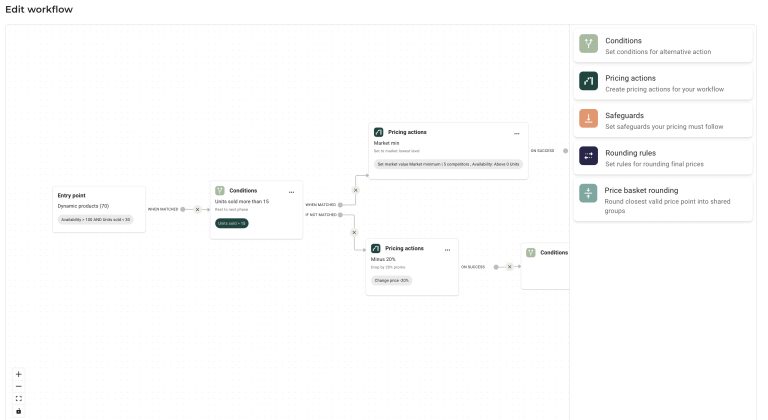
The system learns patterns across your catalogue, price elasticity by product, category, competitive sensitivity (cross-elasticity) by SKU tier, seasonal demand curves, and generates price recommendations based on those patterns plus real-time signals. AI pricing can surface opportunities a rulebook would miss: products where you have more pricing power than you thought, or categories where aggressive pricing doesn’t actually drive volume. Naturally, this approach requires live integration to the pricing software, as the sales need to be monitored live or at least by the hour. This enables also then different scenario building with pricing automation workflow editor‘s that offer conditions (IF / THEN) for your business logic.
AI pricing requires more data to work well (especially your sales data and zero selling / inventory data) and typically needs a longer ramp-up period. It also requires more trust from your pricing team: if the system recommends something that seems counterintuitive, you need confidence in the model before approving it at scale. Preferably, from a intuitive UI…
The practical answer
Most mid-market (300m to 5bn USD) non-food retailers start with rule-based pricing for speed and control, then layer in AI capabilities as their data matures. The two approaches aren’t mutually exclusive — a good platform lets you run rule-based strategies on some categories while AI-driven strategies run on others (like private labels), with the ability to compare performance over time.
The five inputs that drive dynamic pricing decisions
Whatever approach you take, dynamic pricing decisions are only as good as the inputs feeding them. Here are the five that matter most for non-food retailers:
- Competitor prices. The baseline. For most non-food categories, competitor price position is the primary driver of purchase decisions. Your pricing system needs live or near-live feeds from the competitors that matter in each category — not just the market minimum, but the distribution of prices across the market.
- Inventory levels. A product with 400 units and 3 weeks of sell-through runway needs different pricing logic than one with 4,000 units and the same runway. Inventory-aware pricing prevents the common pattern of maintaining full price too long, then scrambling with deep discounts at end-of-season.
- Sales velocity. How fast is this product actually selling at its current price? A product selling at 120% of forecast has different pricing headroom than one at 60%. Sales velocity data helps the system distinguish products that need a price stimulus from those that are already performing and can sustain or grow margin.
- Margin targets and safeguards. Every pricing decision needs a floor and a ceiling. Your pricing system should know the minimum acceptable margin for each product or category, and treat that as a hard constraint — not a guideline. In Pricen, these are called both margin targets and safeguards: a price floor (e.g., minimum 15% margin) and a price ceiling (e.g., no more than 20% above current price) that the system will never breach, regardless of what the rules or AI recommend.
- Business rules and strategy. Pricing isn’t purely quantitative. Your pricing system needs to know about campaign periods, exclusive launches, conidtions happening (IF/THEN), key value items you’re protecting competitively, and categories where you’ve made a strategic choice to lead on price. These strategic overlays sit on top of the data-driven logic.
Dynamic pricing in practice: four non-food verticals
The mechanics of dynamic pricing look different depending on the category. Here’s how it plays out across the verticals where non-food retailers are seeing the most impact:
Fashion and apparel
Fashion pricing (Read a case on NYDJ and AI Markdowns) is fundamentally a sell-through management problem. Every piece of inventory has a season clock ticking, and pricing needs to respond to that clock continuously. Dynamic pricing in fashion means monitoring sell-through rates weekly (or daily for fast-moving categories), adjusting prices when sell-through falls behind forecast, and avoiding the end-of-season clearance scramble that destroys margin. In the end, it is about days, not weeks, when you have to react on it.
The key inputs here are inventory age, size distribution (a size that’s nearly sold out has different pricing power than one with full depth), estimated end stock, and competitor promotional activity. Fashion retailers that implement dynamic pricing typically shift from 2–3 planned markdown events per season to a continuous repricing cadence: smaller, more frequent adjustments that keep sell-through on track without training customers to wait for big sales and by the end a clearance or markdown process that ends the season.
Home and DIY
Home and DIY pricing is driven by seasonality and competitive intensity. The spring garden season is highly predictable; getting pricing right in that 8-week window makes or breaks category performance. Competitor monitoring matters a lot in big-ticket categories (power tools, outdoor furniture) where customers actively compare before buying. Read a case study from BHG.
Dynamic pricing for home and DIY retailers often focuses on a small set of key value items, the products customers use to benchmark price perception (often called traffic drivers),and automates competitive matching on those, while allowing more margin on the broader catalogue. The risk to avoid is cost-plus pricing on items that competitors are using as traffic drivers: your customers notice when your BBQ is 15% more expensive than everyone else’s, even if they never notice your paintbrush prices.
Consumer electronics
Electronics (see case from Lumise) is the most competitively intense non-food category for pricing. Smartphones, laptops, and gaming hardware are repriced many times per day by the major online players. For physical and hybrid retailers, this means pricing needs to be updated at minimum daily, with real-time alerts when major competitors make significant moves on headline products.
Safeguards matter enormously in electronics. The speed of competitive repricing means a misconfigured rule can push prices below cost quickly. Proper price floors (typically minimum margin or minimum cost-plus threshold) are non-negotiable. Electronics retailers also benefit from zone-level pricing: online pricing typically needs to be more competitive than in-store, where the service and immediacy justify a modest premium. In many cases also floating average cogs can be used as the industry does work on retro payments and changing unit costs.
Sporting goods
Sporting goods combines fashion-style seasonality with event-driven demand spikes. Running shoes sell differently in January (New Year resolutions) than August. Ski equipment has a hard season window, known very well by brands like Scandinavian Outdoor. Football boots spike around World Cups and major tournaments. Dynamic pricing for sporting goods means building seasonal rules that change pricing posture by month, while staying competitive with specialist online retailers who often lead on price.
How to set up dynamic pricing without a data science team
The perception that dynamic pricing requires dedicated data scientists, pricing analysts or months of IT project work is the biggest barrier to adoption for mid-market retailers. It’s largely a myth, at least for modern platforms.
Here’s a practical setup sequence that a pricing manager or category manager can own:
Step 1: Define your product scope
Don’t try to dynamically price everything at once. Start with the categories where competitive positioning matters most and where you have decent competitor price data. For most non-food or consumables retailers, this is a defined set of 500–2,000 SKUs in 2–3 categories, not the full catalogue. It must really be your traffic drivers that matter.
In a well-designed pricing platform, you select products for a dynamic pricing strategy either by fixed list or by dynamic filter (e.g., “all products in category X with a competitor data match”). The dynamic filter approach means new products automatically enter the strategy when they meet the criteria — no manual maintenance required.
Step 2: Set your pricing rules
Define the competitive position you want to hold for each product group. Common starting rules include:
- Match the market minimum price (for KVIs and traffic-driving products)
- Stay within 3% of the market average (for most catalogue products)
- Price at market average plus 5% (for exclusive or differentiated products)
Rules should reference competitors selectively. You don’t need to match every player in the market. Define which 3–5 competitors matter in each category and build your rules around them.
Step 3: Configure your safeguards
This is the step most teams underinvest in, and it’s the most important one. Before any automated repricing goes live, set hard limits the system cannot breach:
- Price floor: Minimum margin percentage (e.g., never go below 22% gross margin)
- Price ceiling: Maximum increase from current price (e.g., never raise by more than 15% in a single repricing cycle)
- Category-level exceptions: Products that should never be auto-repriced (exclusive launches, clearance lines already in a markdown strategy)
Safeguards aren’t just a safety net: they’re the mechanism that lets your pricing manager trust the automation enough to let it run. Without clear guardrails, teams either don’t adopt automated pricing at all, or they approve every price change manually and get none of the efficiency benefit.
Step 4: Choose your approval workflow
Most pricing teams start with a semi-automated workflow: the system generates price suggestions daily, and a pricing manager reviews and approves them (or applies them in bulk with a single click). As confidence builds, the workflow typically shifts to fully automated execution with exception alerts, the system runs, and you only see prices that hit the edge of your defined rules.
The ability to move between these modes (without reconfiguring the whole system) is one of the most practical features to look for in a pricing platform.
Step 5: Set your repricing schedule
How often should prices update? For most non-food categories, daily repricing is more than sufficient and manageable. Depending of course if you are using ESL’s or Electronic Shelf Labels or not. Consumer electronics may warrant more frequent updates for a subset of headline products. Fashion sell-through pricing typically runs on a weekly or bi-weekly cadence tied to sell-through review.
Start with a frequency you can comfortably review and audit. You can always increase velocity once your team is comfortable with what the system is doing and why.
Measuring dynamic pricing ROI: the metrics that matter
Implementing dynamic pricing without a measurement framework is like running a promotion without tracking uplift. You won’t know if it worked, and you won’t know how to improve it.
The metrics that give a genuine read on dynamic pricing performance:
- Gross margin percentage by category. The clearest signal. Compare margin before and after implementation, controlling for cost changes. Expect to see improvement in categories where you were systematically under-pricing. Also depending on the products, you may want to monitor the over all sales velocity here as well. If the market is declining, the velocity is all that matters.
- Price position vs market (competitive index). Are you holding your intended competitive position? A competitive index score shows where you sit versus your target benchmark across the monitored catalogue.
- Sell-through rate. Particularly relevant for seasonal categories. Are products clearing at the intended rate, or are you accumulating inventory that will require deeper discounts later?
- Revenue at full price. What percentage of your revenue comes from products sold at their intended price (as opposed to marked-down or promotional prices)? Dynamic pricing should increase this over time by keeping prices appropriately positioned rather than requiring clearance events.
- Time spent on manual pricing tasks. Track how many hours per week your pricing team spends on price changes before and after implementation. A 40–50% reduction is achievable in most deployments.
One measurement pitfall to avoid: comparing total revenue before and after without accounting for macro factors (market growth, promotional calendar changes, competitor activity). Run a controlled comparison where possible, dynamic pricing on a set of categories, static pricing on a comparable control set, to isolate the effect.
Common dynamic pricing mistakes (and how to avoid them)
Pricing everything at once
Starting with the full catalogue before you have confidence in your rules and safeguards is the most common early mistake. The compounding effect of misconfigured rules across 50,000 SKUs is much more damaging than the same misconfiguration across 500. Scope tightly, prove the model, then expand.
Ignoring price architecture
SKUs don’t exist in isolation. They sit in category hierarchies, brand families, and good/better/best structures. A dynamic pricing system that optimises each SKU independently can create irrational price ladders: a premium variant that’s suddenly cheaper than the standard, or a private-label product priced above a national brand. Your rules need to account for relative pricing within families, not just absolute market position.
Setting and forgetting safeguards
Cost structures change. A price floor set at 12% margin may become inadequate after a supplier cost increase. Safeguards need to be reviewed quarterly and updated when underlying cost data changes — they’re not a one-time configuration.
Optimising for the wrong objective
Dynamic pricing rules optimised purely for competitive price position will erode margin on products where you have pricing power. Rules optimised purely for margin will erode competitive position on KVIs. The most effective pricing strategies segment products by their strategic role and apply different objectives to each segment.
How Pricen handles dynamic pricing for non-food retailers
Pricen is built around the idea that enterprise-grade dynamic pricing shouldn’t require an enterprise-grade implementation project. Easy to implement, easy to configure. The dynamic pricing module is designed to be configured by a pricing manager, not a data engineer, and to run with the level of automation your team is comfortable with.
In practice, this means:
- Flexible product selection. Choose a fixed product list or a dynamic filter that automatically includes products meeting defined criteria. Useful for adding new catalogue entries to an existing strategy without manual intervention.
- Configure the UI, easily and as you wish. Set columns and data as you want it to be when you reprice.
- Configurable pricing rules. Set competitive positioning rules by selecting which competitors to benchmark, which operator to use (market minimum, market average, specific competitor), and by what margin or percentage to position relative to the benchmark.
- Safeguards as a first-class feature. Price floors (based on minimum margin) and price ceilings (based on maximum percentage increase) are configured per strategy, not as an afterthought. The system will not generate price suggestions that breach your safeguards.
- Approval workflows you control. Auto-approve all suggestions, require manual approval for all, or set threshold rules (auto-approve changes below 5%, flag for review above). The workflow can be adjusted without reconfiguring the strategy.
- Pricing groups. Keep related products priced consistently, synchronise prices across parent/child variants, colour families, or custom groupings. Useful for maintaining price architecture in fashion and CE.
- Zone pricing. Run different pricing strategies by geography or store format. Online versus in-store pricing, regional price differentiation, or franchise network pricing — all manageable within the same platform.
- Rounding rules. Ensure suggested prices land on psychologically effective price points (.99, .49, round numbers) rather than generating awkward figures like €27.43.
Most Pricen customers are fully operational within 4–6 weeks of onboarding, competitive pricing live, safeguards configured, and the team running the first approval cycles. That speed matters: every week of implementation delay is a week of potential margin improvement left on the table.
Getting started: a practical first step
The retailers who get the most from dynamic pricing software are the ones who start narrow and expand thoughtfully. Pick one category where competitive positioning matters and where you have reasonable competitor data coverage. Set conservative rules and safeguards. Run the system in suggestion-only mode for two weeks while you review what it would have done. Then turn on automation and watch the numbers.
The goal isn’t to automate everything — it’s to make your pricing team faster and more systematic, with the confidence that the rules they’ve set are being applied consistently across the catalogue, every day, without the spreadsheet marathon.
If you’re evaluating dynamic pricing software for your retail operation, book a demo with Pricen — we’ll walk through your specific category mix and show you exactly what a first strategy would look like for your business.