
“When does this pay for itself?”
It’s the question your CFO will ask four seconds after you pitch your latest idea on a pricing optimization software. And honestly? It’s a fair question. Enterprise tech is littered with tools that promise transformation and deliver a simple dashboard nobody logs into after week two.
So let’s be upfront about something most vendors tap-dance around: Enterprise pricing software is not a plug-and-play product. Integration typically takes 3 to 6 months depending on your data landscape, system architecture, and how many skeletons live in your ERP closet. That’s the reality for any serious platform connecting to your sales data, product information, and competitive intelligence.
But here’s what those same vendors also won’t tell you: the integration phase itself can be a goldmine, if you approach it right. And once the system goes live, the first 90 days of active use can deliver ROI that makes the entire investment feel like a steal. Against all expectations, to win your CFO on your side.
This post lays out a realistic roadmap on what happens during integration, how to set yourself up for fast wins at go-live, and what the first 90 days of pricing optimization actually look like when you’re not reading a vendor’s fantasy brochure.
Why pricing optimization ROI is worth the wait
Yes, integration takes time. But pricing optimization operates on the single most sensitive lever in your business. Price. Not headcount. Not logistics. Not the office coffee budget. Price.
A 1% improvement in price realization typically delivers an 8–11% increase in operating profit, depending on your margin structure. Read that again. One percent. That’s not theory. That’s the kind of math that makes CFOs sit up straighter.
Consider a retailer doing €200 million in revenue with a 30% gross margin. A 1.5% margin improvement through better pricing is worth €3 million annually. Not from selling more. Not from cutting costs. Just from pricing smarter. Three million euros that were already sitting in your catalog, waiting for someone to notice.
A recent First Insight Study found that 62% of shoppers say price matters more to them now than ever, and they’re willing to switch stores for better deals. Your customers are paying attention to your prices even if you aren’t. The retailers who invest in AI pricing tools are seeing that investment pay back at speed once they’re past integration.
Here’s the key insight. Unlike CRM or ERP where adoption creeps forward over months, pricing decisions happen across your entire catalog every single day. The moment you start improving those decisions, even modestly, the value compounds immediately. That’s why the ROI curve after go-live is so steep. When you price a price a product, the next order comes with it. Pricing is fastest way
The integration phase: 3–6 months of building the foundation
Let’s not sugarcoat it. Integration is real work. You’re connecting sales data, product catalogs, cost structures, competitive intelligence, and pricing rules into a single platform. Depending on how clean your data is (be honest with yourself here) and how many systems are involved, this takes 3 to 6 months for most mid-to-large retailers.
But integration doesn’t have to be dead time. Think of it as spring training. The smartest retailers use this period to lay the groundwork for fast ROI at go-live. Here’s how.
Plan your data right
The integration phase forces you to confront your data quality. That’s actually a gift, even if it doesn’t feel like one at the time. Use it to clean up product hierarchies, standardize cost inputs, and map competitive data to your catalog. The retailers who invest in data quality during integration see dramatically faster results when the system goes live. The ones who don’t spend months wondering why the recommendations look odd.
Don’t set goals too high
This is where ambition becomes the enemy of progress. If your plan at launch is to “optimize all pricing across every category and channel simultaneously,” here’s what will happen. You won’t. You’ll drown in complexity and produce nothing actionable. We’ve seen it. It’s not pretty.
Instead, pick your battles. Choose 2–3 specific, measurable hypotheses to tackle first. Narrow enough to execute well. Broad enough to prove the model works. Think of it as a pilot, not a moon landing.
Choose your first hypotheses wisely
Here’s an example what works as a starting point, and none of these require advanced AI. They require something far more rare. Visibility, control, and discipline. Especially in today’s hectic world, these simple principles take you far.
- Clear visibility into your pricing landscape. Most retailers don’t actually have a single view of their prices across channels, stores, and product groups. This sounds embarrassing for a data-rich industry, and it should be. Just establishing this visibility reveals problems worth fixing.
- Strategic price management. Getting prices and margins under control. Ensuring your pricing rules are actually being followed, that margin floors aren’t being breached while nobody’s watching, and that price positions reflect strategy rather than whatever someone typed into a spreadsheet three years ago.
- Fix the outliers. Every catalog has them. Products sitting at wrong price points for no good reason. Discount that is lingering itself to death. Some are underpriced and quietly leaking margin every day. Others are overpriced and wondering why nobody buys them. Finding and fixing these outliers is often the single fastest path to measurable improvement.
- React faster to competition on high sellers. You don’t need an AI model to know that your top-100 products need competitive prices. But you do need a system that spots when a key competitor drops their price and alerts you within hours, not sometime next quarter when someone happens to check.
- Optimize private labels. Here’s a secret hiding in plain sight. Private label products are where you have the most pricing freedom and the highest margin potential. They’re also where retailers most often underprice, because there’s no direct competitor benchmark to anchor against. It’s about branding and getting private label pricing right is a quick, high-impact win that competitors can’t easily copy.
- Manage categories and quality classes properly. Not all products in a category should be priced the same way. A premium-tier product and an entry-level alternative need different pricing logic. Their price increments must stay right. This sounds obvious. You’d be surprised how many retailers treat their entire category as one homogeneous blob. Establishing clear quality class management is a structural fix that pays dividends across every pricing decision that follows.
These are not flashy. They won’t make a great keynote presentation. They’re not “AI-powered” or “next-gen.” But together, they deliver a massive impact, often before you’ve turned on a single machine learning model.
The first 90 days after go-live: where ROI gets real. Integration is done. The system is live. Your team has access. Now what?
Here’s what a realistic post integration 90-day ROI roadmap looks like, for people who live in the real world.
What is realistic, can also be achieved. We created an example ROI roadmap for your pricing project for up to 90 days. See below.
Visibility, control, and the first quick wins. The first month is about activating the groundwork you laid during integration. And if you did that groundwork well, this part can feel almost unfairly easy.
What happens:
Your team now has a single platform showing prices, margins, competitive positions, and performance data across your catalog. No more toggling between seven spreadsheets and a prayer. The pricing automation layer starts enforcing the rules you defined: margin floors, competitive matching logic, and category-specific strategies.
The outlier fixes you identified during integration go live. Mispriced products get corrected. Competitive gaps on key value items close. Private label pricing gets aligned to the actual strategy, not to whatever legacy Excel file someone last updated in 2023.
Where ROI shows up:
Time savings hit immediately, and they’re not small. NYDJ, the premium women’s denim brand, achieved a 50% reduction in time spent on pricing operations after implementing Pricen’s markdown optimization. Fifty percent. That’s not a rounding error. That’s your pricing team getting half their week back to do actual strategic thinking instead of spreadsheet wrangling.
Beyond time, the margin improvement from fixing outliers and enforcing rules is typically visible within the first few weeks. It’s common for retailers to discover that 10–15% of their catalog is priced suboptimally relative to costs, competitors, or demand. Fixing those gaps requires nothing more sophisticated than visibility and speed. The profit was always there. It just needed someone to look.
Expanding scope and testing strategies
By the second month, the low-hanging fruit is picked. The easy wins are in the bank. Now it’s time to get more strategic.
What happens:
The price simulator becomes the team’s new favourite toy (and their most useful one). Instead of guessing what a 5% price increase on a category will do, your team can model it. Forecast the volume impact, the margin effect, and the competitive response, all before making a single live change.
This is where you start expanding beyond your initial hypotheses. New categories come under active management. Markdown strategies get tested on end-of-life products. Promotional pricing gets evaluated against actual performance data rather than whoever shouted loudest in the last planning meeting.
The focus is still on strategic pricing management, not full AI optimization. And that’s exactly the right sequencing. You need to know where you’re going before you let an AI drive you there.
Where ROI shows up:
Margin improvement on newly managed categories becomes visible. The simulator prevents costly mistakes, because the deals you don’t do are sometimes more valuable than the ones you execute. And something less measurable but equally important happens. The team’s confidence in data-driven pricing decisions grows. They stop debating opinions and start testing hypotheses.
Measurable results and the AI layer kicks in. By the third month, the strategic foundations are solid. The team trusts the system. The data is flowing. Now the AI earns its keep.
What happens:
The platform has been collecting transactional data since go-live, and the AI has been learning quietly in the background. Order volumes, price sensitivity patterns, cross-product effects, seasonal signals. For example Pricen’s reinforcement learning approach means the AI doesn’t just crunch historical averages. It actively tests and learns, refining its recommendations based on what actually happened, not what a static model predicted.
The first AI-driven, demand-based pricing recommendations go live. Typically these start on your highest-volume or highest-margin categories where the data is richest. Safeguards, including margin floors, price ceilings, and category-specific rules, ensure the optimization stays firmly within your strategic boundaries. The AI is smart, but it plays by your rules.
For fashion and seasonal retailers, this is when markdown optimization starts to really shine. Rather than applying blanket end-of-season discounts (the pricing equivalent of shouting “everything must go!”), the system recommends the optimal timing and depth for each markdown, maximizing sell-through while protecting margin.
NYDJ saw this firsthand. After implementing Pricen’s AI-powered markdown optimization, they moved stock 2.6x faster while selling 7% more inventory. That’s not a marginal improvement. That’s a fundamental shift in how markdowns perform. The kind of shift that makes your merchandising team wonder how they ever did it the old way.
Where ROI shows up:
By day 90, you should have hard numbers: measurable profit lift from both the strategic fixes (visibility, outliers, competitive alignment) and the first AI-driven optimizations layered on top. The ROI conversation with your CFO shifts from “when will this pay off?” to “how fast can we scale this?” That’s a much better meeting to be in.
What real-world ROI actually looks like
Enough theory. Here’s what retailers are actually seeing once they get past integration and into active use.
NYDJ (Not Your Daughter’s Jeans), a leading global women’s apparel brand known for inclusive sizing and premium fits, partnered with Pricen to optimize their markdown and progressive “furthers” pricing strategies. With a broad assortment across categories and channels, NYDJ needed to make markdown decisions quickly, strategically, and at scale. Spreadsheets and static rules weren’t cutting it. The results after implementing Pricen’s markdown optimization were clear:
- 2.6x faster stock rotation through smart, AI-driven markdowns
- 7% more inventory sold with optimized discount timing
- 50% reduction in pricing operations time, half the manual work, better outcomes
As Tara Ragan, EVP of Planning and Operations at NYDJ, put it:”the platform gives their team confidence that pricing is working with them, not against them. They can act faster, test smarter, and keep focus on the bigger picture of meeting customer demand while protecting their bottom line. NYDJ is now exploring how to extend Pricen’s capabilities to initial pricing and promotional planning, building on the markdown success.”
NYDJ achieves 2.6x faster stock rotation with smart markdowns
While exact figures are confidential, early results show NYDJ is executing price changes faster, cutting manual work, and boosting margins with smarter, better-timed markdowns.
- Sell through 7% more inventory with smart markdowns
- Move stock 2.6x times faster with Pricen
- 50% reduction in time spent on pricing operations

Across the broader industry, the pattern holds. Once past integration, retailers typically achieve 1–2% margin improvement within the first 90 days of active use. Companies using AI-powered pricing report gross profit increases of 5–10% over the medium term. For markdown-heavy categories like fashion, the improvement in sell-through rates can be even more dramatic, which is exactly what NYDJ experienced.
The honest timeline: integration is the investment, quick wins are the payoff
Here’s how the full journey looks, with no hand-waving:
Integration
Data connections, system setup, cleaning product hierarchies, defining business rules and strategies. This is the foundation. It takes time. The retailers who use this period to plan their first hypotheses and clean their data are the ones who hit the ground running at go-live. The ones who treat integration as “an IT thing” are the ones who don’t.
Quick wins
Visibility, outlier fixes, competitive alignment, private label optimization, quality class management. None of this requires AI. It requires a system that gives you control and clarity. The impact is often immediate and surprisingly large. This is also where your team starts to think, “Why didn’t we do this sooner?”
Strategic expansion
Broader category management, simulation-driven strategy testing, initial markdown and promo optimization. The team stops relying on gut feel for decisions that affect millions in revenue.
AI layer initially brings in results
Demand-based pricing, reinforcement learning optimization, and automated recommendations start delivering value on top of the strategic foundation you built. This is where the compounding effect really kicks in, and where the ROI curve goes from encouraging to impressive.
The total timeline from project start to measurable ROI? Roughly 6–9 months for most mid-to-large retailers. That’s honest. But the 90 days of active use after go-live consistently deliver enough value to justify the entire investment, often several times over.
What accelerates (or delays) your ROI
Not every retailer hits ROI at the same speed. Some sprint. Some meander. Here’s what separates the two.
What accelerates ROI
- Start narrow, prove the model, then scale. The retailers who see the fastest results pick 2–3 specific hypotheses (fix outliers, optimize private labels, improve competitive response on key items) and execute them well before expanding scope. Boring? Maybe. Effective? Always.
- Define clear business rules upfront. Minimum margins, competitive positioning rules, markdown cadence. The clearer your rules, the faster the system can operate within them. Pricen’s workflow editor makes these rules visible and editable, so nothing hides in a black box.
- Invest in data quality during integration. Clean product hierarchies, accurate cost data, and well-mapped competitive intelligence make everything that follows faster and more accurate. Think of it as sharpening the axe before chopping the tree.
- Get executive buy-in early. When the CFO or Head of Commercial champions the initiative, adoption is faster and resistance is lower. Showing real customer results from retailers who’ve already made the move tends to do the trick.
What delays ROI
- Trying to attack every pricing problem at once. If you try to fix visibility, competitive positioning, private labels, promotions, markdowns, and AI optimization all on day one, you won’t fix any of them well. Sequence your priorities. The companies that focus on a clear, manageable set of hypotheses first always outperform those who try to boil the ocean. Always.
- Waiting for “perfect” data. Your data doesn’t need to be flawless. It needs to be good enough. Modern pricing tools are built to work with imperfect inputs, clustering similar products, estimating elasticity from partial history, filtering noise from competitor feeds. Waiting for perfect data is the most expensive delay there is, because perfect data doesn’t exist.
- No clear owner. Pricing optimization works when someone owns it: a pricing manager, a category lead, a Head of Commercial. If it’s everyone’s job, it’s nobody’s job. That’s not a management platitude. It’s the single best predictor of whether a pricing project succeeds or quietly dies.
How Pricen gets retailers to ROI faster
Pricen is designed to deliver value at every stage of the journey, not just when the AI switches on.
During integration, Pricen’s team works with you to structure your data, define your pricing strategies, and identify the highest-impact hypotheses to tackle first. The goal is simple: make go-live day productive from hour one, not month one.
At go-live, the platform gives you immediate visibility and control. Pricing automation enforces your rules. The price simulator lets you test strategies with 95% forecasting accuracy before committing. The visual workflow editor makes every pricing rule transparent and editable, so your team understands and trusts what the system is doing. No black boxes. No “just trust the algorithm.”
When AI activates, Pricen’s reinforcement learning engine starts optimizing prices based on actual demand patterns from your data, not generic industry models. Safeguards protect your margins at all times. Automation only operates within the boundaries you set. It’s your strategy, executed at a speed and precision no spreadsheet can match.
Enterprise software takes time to start, but the payoff is real
Let’s be honest about the full picture. Pricing optimization is an Enterprise software. Integration takes months, not days or weeks. Anyone who tells you otherwise is selling you something simpler than what you need.
But here’s the thing. Once you are live, the quick wins can be remarkably quick and clear. Getting visibility into your pricing landscape. Fixing outliers. Aligning competitive positions. Optimizing private labels. Managing quality classes. These fundamentals alone deliver massive impact, often within the first weeks of active use. No AI required. Just clarity, control, and the willingness to look at your own pricing honestly.
Then, on top of that foundation, the AI layer kicks in. Demand-based pricing. Reinforcement learning optimization. Automated markdown strategies that move stock 2.6x faster, as NYDJ proved.
The real risk isn’t that the investment takes time. It’s waiting too long while margin leaks go unnoticed, markdowns destroy value, and competitors who already invested are pulling ahead, one optimized price at a time.
Ready to see what smarter pricing could mean for your business?
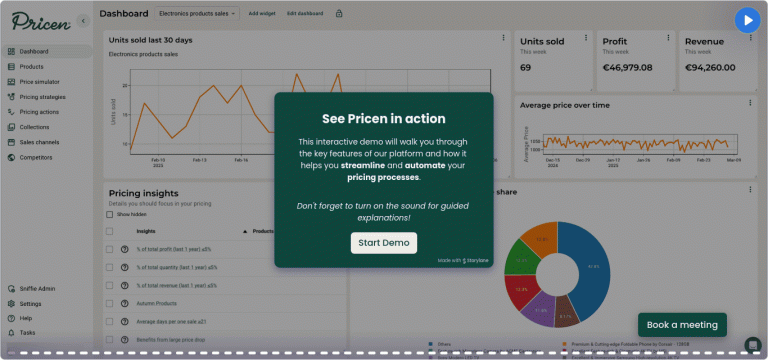
Take a spin of Pricen with our quick, informative and fun demo.
Your questions answered
Common questions
How long does it take to see ROI from pricing optimization software?
The honest answer has two parts. Integration typically takes 3 to 6 months for mid-to-large retailers, depending on your data landscape and how many systems need to connect. That’s the reality for any serious enterprise pricing platform. But once the system goes live, most retailers start seeing measurable results within the first 30 days of active use, starting with quick wins like fixing mispriced products, closing competitive gaps, and getting visibility into their pricing landscape. By day 90, the AI layer is delivering demand-based optimization on top of those strategic foundations. The total timeline from project start to hard ROI numbers is typically 6 to 9 months, but the 90 days after go-live consistently deliver enough value to justify the entire investment.
What are the first quick wins from pricing optimization?
The fastest results come from things that don’t require AI at all. They require visibility, control, and discipline. The most common quick wins include: getting a single view of your prices across channels and stores, fixing outlier products that are mispriced relative to costs or competitors, aligning private label pricing to capture the margin potential most retailers leave on the table, reacting faster to competitive price changes on your highest-selling products, and establishing quality class management so premium and entry-level products aren’t priced with the same logic. These fixes are not flashy, but retailers regularly find that 10 to 15% of their catalog is priced suboptimally, and correcting that delivers margin improvement within weeks.
Do you need perfect data to start with pricing optimization?
No, and waiting for perfect data is the most expensive delay there is, because perfect data doesn’t exist. Modern pricing platforms are built to work with imperfect inputs. They cluster similar products, estimate elasticity from partial transaction history, and filter noise from competitor feeds. What matters is that your data is good enough: reasonably clean product hierarchies, accurate cost information, and at least 6 to 12 months of sales history. The integration phase is actually the best time to improve data quality, because the process of connecting your systems naturally forces you to confront and clean up inconsistencies. Retailers who invest in this during integration see dramatically faster results at go-live.