Dynamic Pricing Software for Omnichannel retailers

Price every market you trade in on its own terms, from your zones down to a single store.

Dynamic pricing price cards showing various competitor prices and how dynamic pricing software react to competition.

Dynamic pricing software that respects local markets

One national price list is a compromise. What wins in a city centre store loses margin in an outlet, and what your webshop competes against is not what your stores compete against. Pricen’s Dynamic Pricing Software lets you run one set of pricing logic and still land a different, correct price in every market: per country, per pricing zone, per channel, per store.

You set the rules. Prices move against live competitor data and your own sales, costs and stock, every day or on the schedule you choose. Every suggestion arrives with the full breakdown of how it got there, so nothing goes live that you cannot explain.

Omnichannel dynamic pricing, down to the store

Run the same strategy across ecommerce, marketplaces and physical stores without flattening the differences between them. Scope a strategy to a store, a group of stores or a pricing zone, and let each one price against the competitors that actually sit in its market. Set the market reference you want to hold: market minimum, median, mean or a fixed position against a named competitor. Every price suggestion shows which stores it applies to.


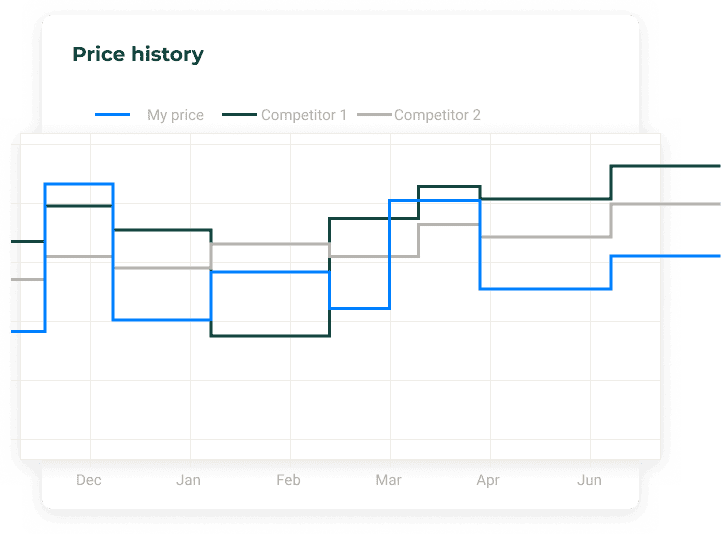
Market price history is important to know in dynamic pricing

Scenarios you build yourself, in the workflow editor​

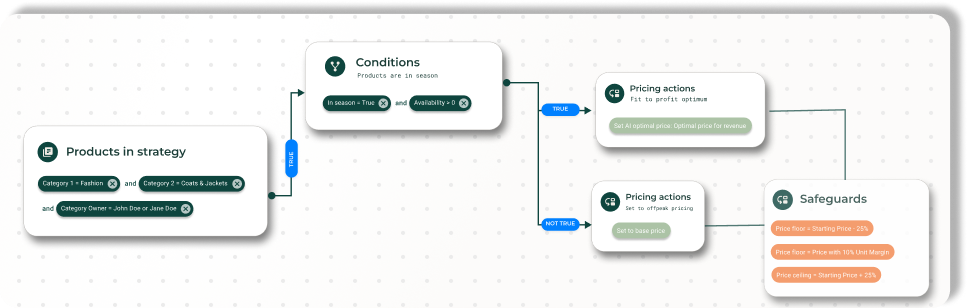
Pricing rarely fits one rule. In the workflow editor you draw the logic on a canvas: a condition splits your catalogue into two paths, each path gets its own pricing actions, and each branch can carry its own safeguards and rounding. Products with competitor data match the market. Products with none fall back to cost plus margin. Slow movers route to a markdown branch. Name every node, watch the product count at each one, and you can see exactly which products took which route.

A pricing workflow example on Pricen

Functions: your own data, your own logic

Functions is the low-code layer on top of everything else. Write a formula from your own product variables, save it, and it runs live against your whole catalogue in about a second, even at 160,000 SKUs. Classify products as Star, Volume or Laggard by margin and velocity. Cap a variant at 96% of its anchor price. Flag promotions that have gone stale. Pull in outside signals like weather, Google Analytics or ERP fields and price against those too. Functions can reference other functions, so one definition is published once and every team works from the same one.

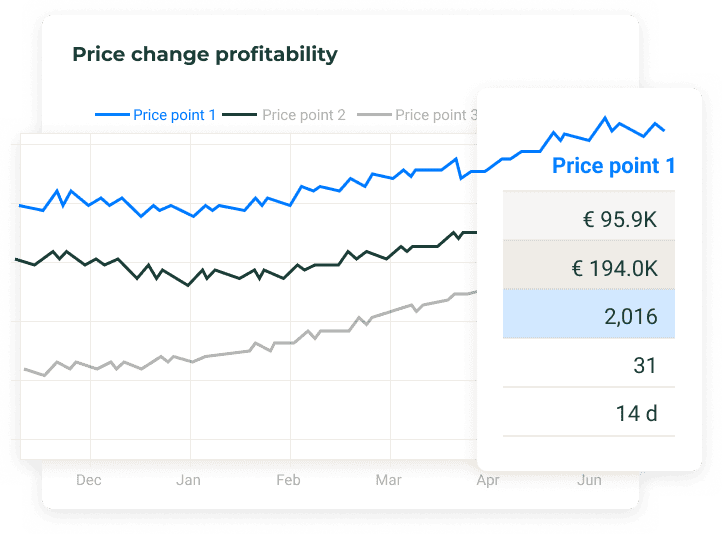
Price change profitability

Automation you can hand over, and take back

Every suggested price runs through safeguards, price grouping, rounding and a minimum change check before it reaches you. Margin floors and price ceilings override anything a rule produces. By default you approve the batch; switch on auto approval per strategy once you trust it, and keep manual review on the categories where you want it. The full step by step trail, including any failed actions, stays visible in the pricing log.

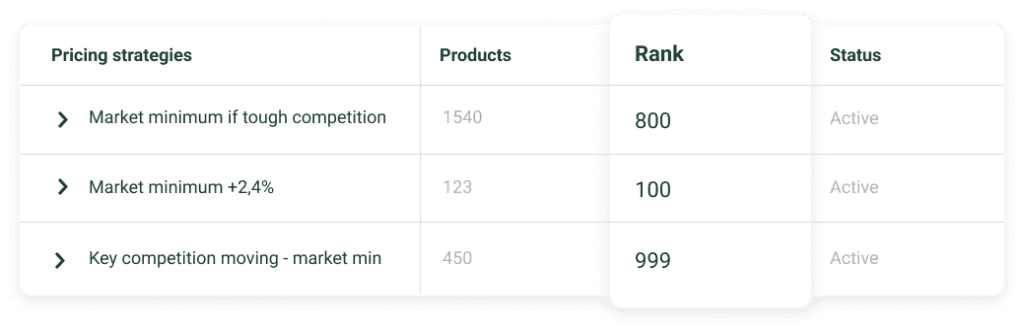
Dynamic pricing strategies

“We have secured significantly more sales and profit.

The results with Pricen have been fantastic. We have secured significantly more sales and profit. I am super happy with Pricen as a SaaS service.”

Tomi Kottonen Hyvinvoinnin Tavaratalo

Tomi Kottonen, Founder, Hyvinvoinnin Tavaratalo

Pricen character price point

Category managers

Set the market position each category should hold, and let the rules keep it there across every store.

Marketing department

Pricing managers

Build and rank the scenarios, own the safeguards, and see the reasoning behind every suggested price.

Pricen character price point of man

Ecommerce managers

Match the online market daily while margin floors stop a competitor’s clearance sale from dragging you down with it.

Pricen price point woman reading

Store and regional operations

Give each store a price that fits its own catchment area, without maintaining a separate price list for it.

Who benefits from dynamic pricing?

Why choose Pricen

Priced per market, not per country

Store level and zone level pricing is built in, not a workaround. One strategy, the right price in every market.

Scenarios in a visual workflow editor

Branching pricing logic on a canvas, with per branch safeguards and rounding. Products move between branches on their own as the data changes.

Industrial scale

A Pricen customer changes more than 2 million prices in an hour. Functions run live over 160,000 SKUs in under a second.

Our partners

Dynamic pricing is one layer, not the whole stack

Dynamic pricing sets the day to day market position. Price optimization finds the profit maximising price behind it, and the price simulator lets you test either one before it goes live. They run on the same product data and the same safeguards.

FAQ

Dynamic pricing software uses rules and algorithms to change pricing based on given rules and guidelines. Dynamic pricing software is used in Ecommerce to dynamically reprice products based on market changes, demand, seasonality, and market shortages.


Yes. A strategy can be scoped to a store, a store group or a pricing zone, and each one prices against its own market.

Dynamic pricing software best fits competitive business spaces where prices tend to change rapidly. It is vital for businesses where customers are highly price-sensitive and reacts quickly to price changes, and their products are easily comparable and sold by many vendors.

Not by default. Suggestions wait for you. Auto approval is a per strategy setting you turn on when you are ready.

You route them down a fallback branch in the workflow editor, usually with internal data guidelines or an internal reference value. You can also use our elasticity models to reprice.